
Franchises. Some good, some bad. There are many ways to evaluate a potential franchise that you’re trying to work with, but a common metric to look at are failure rates.
However, you should always be cautious as you’re seeking out these numbers, and make sure to use your best judgment.
I, for one, don’t remember the last time I saw a Snap-On truck, nor do I remember the last time I wanted the services they provide. The official claim is that the Snap-On franchise failure rate is claimed to be near 0%.
Franchises can be a great way for you to become an entrepreneur without having to figure everything out yourself. You look at some FDDs of prospective companies you’re interested in, you talk to a franchise broker, and see which best aligns with the lifestyle and ROI goals you hope to have for your investment. Heck, you may even be looking for franchisors where you can secure a multi-unit agreement. After that, you get an SBA loan, and you’re off to a thrilling experience of a lifetime. That’s at least the case if everything goes according to plan.
Snap-on Tools Franchise Failure Rate
While I was doing research on Snap-on Tools, I found a lot of contradictory information, and I can’t say they’re the highest on my list of recommended companies.

Officially, they claim the franchise failure rate of Snap-on Tools is near 0%, but it doesn’t sit right with me. Various industry analyses I came across also questioned this number.
When you’re choosing a prospective franchise, it’s important to be skeptical. Anyone, whether a franchising company or otherwise, selling you anything will always try and make it seem as good as it can possibly be.
There’s a lot of speculation that Snap-on Tools is great at making the failure rate artificially low by buying back or reselling ones that aren’t doing well. I’ve seen various numbers and estimates reported that indicate Snap-on Tool’s franchise failure rate could realistically be about 10%.
Here’s the kicker. The company has been at the center of many lawsuits – 40 to be exact. The complaints include high costs and pressure, claiming that they never really get set up for success.
| 🔧 Key Item | 🐏 Tar Heel Insight |
|---|---|
| Initial franchise fee | $8 000 – $16 000 (discounted if you finance the van through Snap-on Credit) :contentReference[oaicite:0]{index=0} |
| Total investment | $221 751 – $500 098 to launch a fully stocked tool truck; 50 %+ of that is inventory you can floor-plan. :contentReference[oaicite:1]{index=1} |
| Ongoing fees | 8 % royalty on gross sales + 1 % marketing fund, remitted weekly. :contentReference[oaicite:2]{index=2} |
| Territory structure | Protected list of ~300 flagged accounts; only you may call on those shops inside the county-drawn boundary. :contentReference[oaicite:3]{index=3} |
| Hidden gotcha (consultant-level) | Snap-on’s 7-year franchise agreement obligates you to buy all replacement inventory directly from HQ; NC’s resale-tax exemption certificate must list the truck VIN—franchisees who register under their LLC name alone often get dinged at audit for unpaid use tax on promo tools. |
| 🚀 Enquire | Talk to Thomas about franchises ➜ |
Another thing keeps me hesitant in wanting to recommend this company.
Think about it critically. Where do you buy your tools?
I can’t personally say that getting them off the back of a truck is what comes to mind.
It seems that the dissatisfaction with the company is pretty spread out and won’t necessarily turn up for your average search on Google.
There’s another downside as far as I’m concerned. While you’re having to foot the bill, you’ll be carrying a lot of expensive inventory. It’s also a custom truck lease, with claims the support just isn’t there when a franchisee is struggling.
The extensive effort required to make this business go around may not be worth it for everyone. You don’t just happen to buy tools during your lunch break.
With that said, Snap-on annual sales are supposedly an average of $800,000, and if we assume typical franchise margins, you can make $80,000 to $120,000 in profit as an owner of a Snap-on franchise.
Cost
If you’re still curious to seek out this franchise, you are probably interested in what it costs to open a location. That’s where it also gets interesting, and another reason why Snap-On is not a company I would generally recommend that people look into for franchising.
There are many types of businesses that may just not be worth it once you start looking into the specifics.
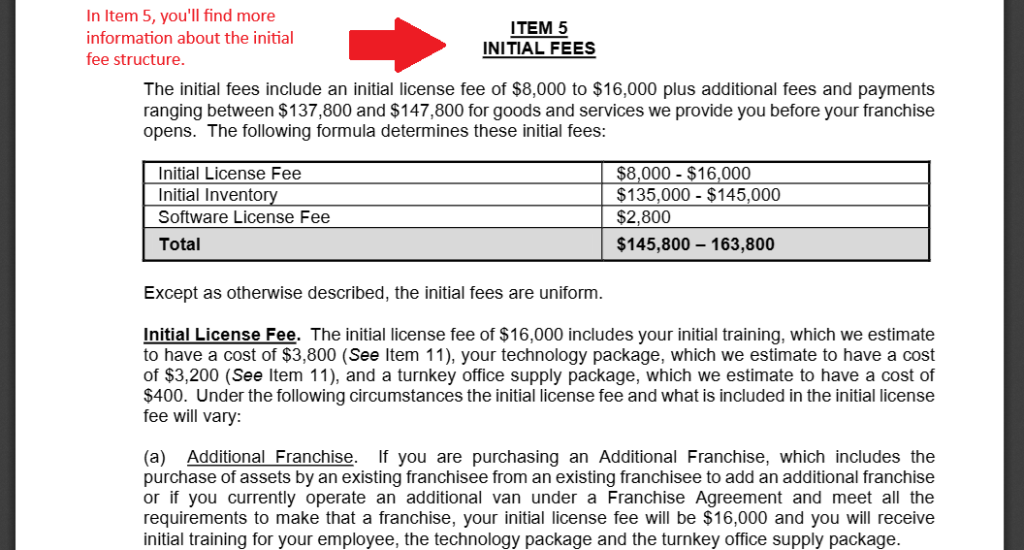
Other franchisors typically require you to pay a franchise fee that ranges from $10,000 to $60,000 per location to get started. The norm is $40,000 to $50,000 per location However, Snap-On’s franchise fee is considerably higher and costs between $145,800 and $163,800. This money covers a range of things, but it almost just feels like you’re set up for failure from the get-go with fees that are way higher than most companies.
When you look at the Snap-On’s FDD, it is structured somewhat weird. The franchise fee is typically listed near the top of the page without having several components lumped into it, but I had to go to Item 5 to actually understand what it entails.
It’s important to note that the overall cost to start with a Snap-On franchise ranges between $217,505 to $481,554. This isn’t the cheapest type of franchise to start, but definitely not the most expensive either.
However, when you look at Item 5 (where initial fees are listed), you’ll see what the company lumps together where the typical franchise fee is reported. In the number stated (145k to 164k), is apparently a lot of initial inventory that is preselected for you. The company states that this is the case to make sure you have a diverse range of inventory.
In addition of the “franchise fee,” $135k to $145k is supposed to be initial inventory. For that suggested inventory, the suggested retail price is $202k to $218k.
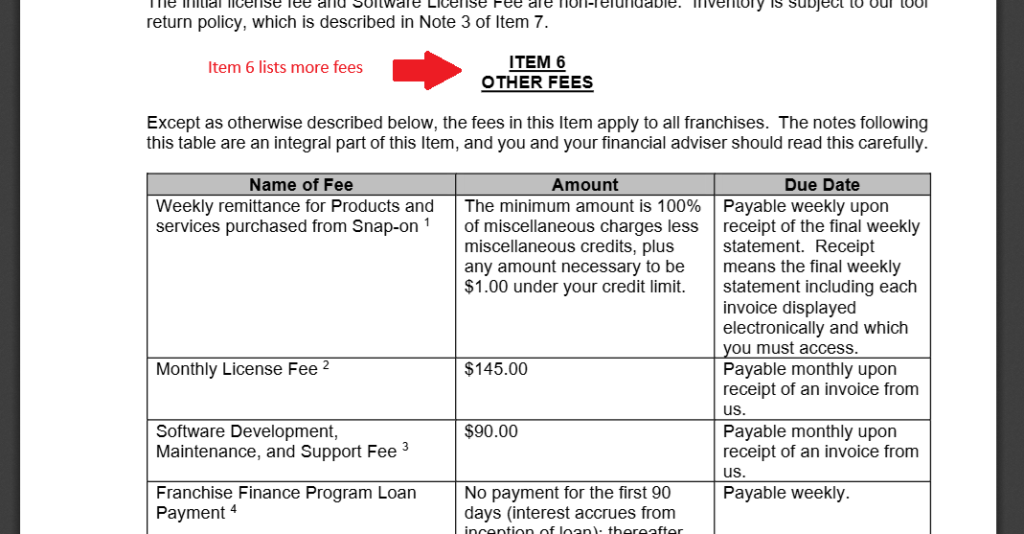
I personally don’t think those are great margins, particularly not when it’s not even a distribution channel I think is relevant in the era that we live in.
I highly doubt the company would be willing to give this to a franchisee before signing with them, but there’s something I would love to get. A line item list with the cost of the inventory you would be required to buy. I would then want to compare that list to the prices of other tool companies out there. Snap-On does pride itself on being a premium tool brand, but I would think the prices are out of whack if I had to guess.
This franchise is a no from me.
Here are some alternatives, or reach out so we can talk about your options.
| 🔧 Franchise | 🚚 Model & Niche | 🧠 Why It’s a Smart Alternative | 🎯 Creative Local Promo (Wisconsin) |
|---|---|---|---|
| Batteries Plus ⚡ | Retail + mobile install/repair (device & vehicle batteries, key-fobs, lighting) | Diversifies beyond mechanics — serves hospitals, schools & fleets; recession-resilient replacement cycle; B2B contracts | “Brats & Batteries” popup at the State Fair — swap phone batteries while fans wait in brat lines 🌭 |
| Garage Living 🚗 | Design-&-install vans for premium garage storage & flooring | Targets high-income homeowners (Lake Country, Fox Valley); higher ticket sizes than hand tools; seasonality opposite auto bays | Host a “Tailgate Garage Makeover” contest with local high-school hockey boosters 🏒 |
| Rolling Suds Mobile Power Wash 🚿 | Fleet & building pressure-washing with dispatch software | Uses similar box-truck assets; taps Midwest salt-corrosion pain point; repeat contracts with logistics hubs & dairies | “Fresh-Rinse Friday” demo outside Madison dairy processors 🥛 |
| Detail Garage (Chemical Guys) ✨ | Pro detailing supply retail + training classes + mobile kits | Cross-sells chemicals, tools & memberships to DIYers AND body-shops; social-media-friendly brand drives foot-traffic events | “Snow-Salt Slam” winter workshop—show how to de-salt cars in Green Bay’s Lambeau Field lot 🥶 |
Leave a Reply