
This is the introduction to our “opening a franchise, part 1”. In it, I’ll take a look at some popular concepts I often hear potential franchisees talking about.
The reality is that not all businesses are right for all people. There may be requirements that makes you ineligible to start off with, or there may be aspects of a business you don’t love. For that reason, I thought it was a great idea to summarize some of the most notable things you should know when considering opening a franchise.
As you may know, there are thousands of different companies that franchise, but there may just be a handful that are right for you. For each opportunity, it’s important for you to evaluate the owner’s salary or profit you can expect, in addition to the probability of earning your target ROI from that business. Here’s part 2 of our “buying a franchise” series.
Little Caesar’s
Little Caesar’s requires candidates to have a minimum net worth of $400,000, of which $200,000 needs to be liquid. However, when you see the required investment, it starts at almost $400,000 ($393,000 to be exact) and ranges all the way up to $1,718,700.
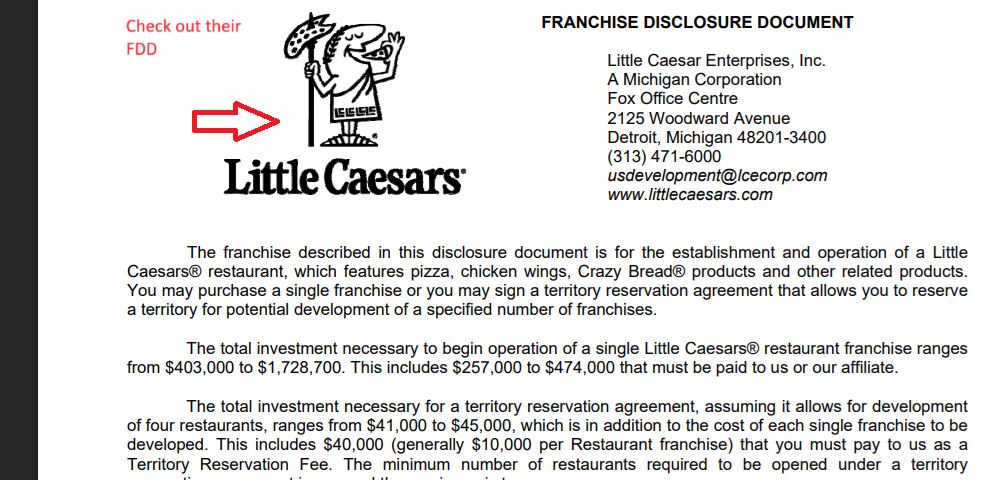
These aren’t just numbers I’m fabricating, but you can look at the company’s FDD to get a better look at the financials they’re reporting, including an Item 19. As such, the cost to open a Little Caesar’s ranges from $393,000 to $1,718,700.
It also includes a $20,000 franchise fee for the first restaurant. On top, your royalty is 6% with an additional 5% in marketing fee.
For the reasons mentioned, along with the severe competition faced when it comes to making pizzas, Little Caesar’s is rarely a franchise I recommend. When you’re taking 11% off the top of your revenue for royalties and marketing, you’re quickly left with considerably less.
Pizza franchises are notoriously fierce, and Little Caesar’s is no exception. They also favor hands-on owners, so if you’re hoping to have this be a passive opportunity, it may not be for you.
Subway
Subway has not been without controversy through the years, and for several reasons. This, too, is not a franchise I often recommend to potential franchisees. It’s just too much of a question how good of a business it is for the actual franchise owners.
They’re undoubtedly known as a mega player in the custom sandwiches space, but they’ve also gotten quite the reputation (at least in industry circles) as only offering very limited protection for franchise owners.
With some of the lowest requirements in the food industry, Subway has managed to draw in big numbers of people that own this franchise. Their low-cost franchise option may have appealed to many, but it has its drawbacks.
Recent years have been particularly brutal for their reputation. When we look at their numbers, nothing stands out as being great either.
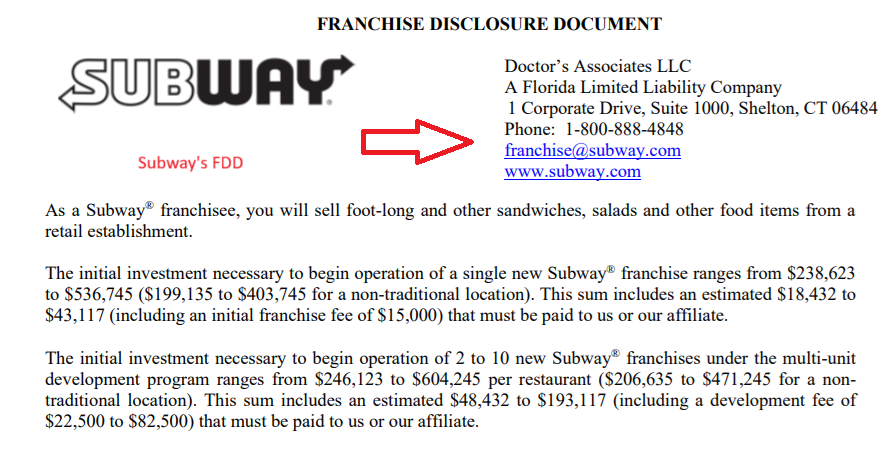
The cost to open a Subway franchise ranges from $229,000 to $522,000, which may seem better than Little Caesar’s, and there’s a “measly” $150k minimum net worth per store. Of that, $100,000 needs to be liquid. Here’s what’s concerning. No food experience is required.
When you look at the fee structure, 8% of gross sales are paid in royalties on top of 4.5% in advertising. A total of 12.5% paid before you even get going is pretty steep if you ask me.
Besides the financials, Subway has gone through a string of scandals. For one, they’re very limited in how much protection they offer franchisees and locations often end up competing geographically. The good thing about the concept is that you won’t smell like frying oil if you choose to own one!
Crumbl Cookies
| 🍪 Key Item | 📋 Crumbl Franchise Insight |
|---|---|
| Initial franchise fee | $50,000 per unit; no multi-unit discounts published |
| Total investment | $367,666 – $1,404,333 including equipment, build-out, POS, training, and working capital (2024 FDD) |
| Ongoing fees | 8% royalty + 2% national marketing fund; local store marketing recommended minimum of $2,000/month |
| Store footprint | Typically 1,200–1,800 sq ft inline retail; white-box or vanilla-shell preferred to streamline build-out and maintain Crumbl’s black/pink aesthetic |
| Product model | Weekly rotating cookie menu model—requires strong training discipline and inventory control to avoid waste. All recipes and suppliers are proprietary and pre-approved. |
| Creative rollout idea | Host a “Cookie Catwalk” opening party with pink carpet, cookie-costumed mascots, and limited-edition flavor voting—tie to Instagram Reels giveaways to capture day-one social buzz |
| Hidden gotcha (consultant-level) | Franchisees are required to purchase all dough from Crumbl’s central commissary—this limits gross margin flexibility. |
| 🚀 Enquire | Talk to Thomas about Crumbl Cookies ➜ |
Crumbl Cookies seem to be all the hype, and their stores are opening rapidly. With a sugar-filled, highly-addictive product, it’s no wonder. Opening a Crumbl Cookies isn’t rocket science, and this simple bakery concept could be for you.
With social media, the concept has taken off. Cookies are baked fresh, and the resulting pictures are often shared online.
An investment ranging from $347 to $692k is a requirement to open a Crumbl Cookies as is a $500k net worth, of which $150k to $200k has to be liquid.
What I like about this business is the support offered by the company and their preference for people with business acumen. With the Instagrammable nature of the business, they lean into current trends in many ways.
While I am often skeptical of food concepts that heavily rotate the menu, Crumbl Cookies may just be the exception. Many food concepts struggle when new elements are introduced, but variations of great cookie recipes will only vary so much from week to week.
Crumbl Cookies has an 8% royalty and 2% marketing fee, which makes those numbers better than alternative concepts we covered. However, those things alone don’t mean the concept is necessarily right for you.
Leave a Reply