
Are you looking to start a new adventure making smoothies or rather selling tools from a mobile truck?
The good news is both can be done as part of a franchise, but that doesn’t necessarily mean it’s a great idea. Here’s part 3 of our on-going series on franchise failure rates (check out part 2 of our series on opening a franchise) where we look at different companies’ performance and what franchisees should expect.
Just because you CAN plow a lot of money into a franchise business doesn’t mean it’s a good idea. As a consequence, potential franchisees often turn to things like franchise failure rates to help them evaluate the viability of a business before committing.
The good news is that it can definitely help you get a better understanding of what has historically been the case for franchisees, but it doesn’t provide a full picture.
To evaluate a franchise, you’ll need to look at a lot of things. For instance, franchises are legally required to provide you with an FDD (franchise disclosure document), which additionally often includes an Item 19.
That is, if the franchise chooses to do so. It’s not always a warning sign if there isn’t one, but I personally don’t like the absence of one when I help potential franchisees.
In this we’ll take a look at the franchise failure rates of Smoothie King and Mac Tools. In part 2, we covered a business similar to Mac Tool, specifically Snap-on Tools. Make sure to bookmark that as well.
Smoothie King
Smoothie King has been the center of scandals with a worrying 28% franchise failure rate. While that number isn’t exactly the most up-to-date number we could come by (it was figured out using SBA loan data), it does suggest that the company has had concernin issues.
Some companies choose to franchise a lot sooner than they’re ready for it, whereas others don’t provide adequate support to the struggling businesses they partner with.
More recent data I came across when researching indicate that the failure rate may have dropped to 8% by year three, but you can’t ignore the past.
New management or changing ideas within companies can lead them to go down the path of suddenly changing directions. When I talk to potential franchisees, I always encourage them to look for past scandals. How were they handled?
Local juice bars is an important thing you know you’ll be competing against, and there have also been complaints about high product costs. Besides the worrisome failure rate in the past, the company at least seems to have tried to right their wrongs from the past.
I also found a history of pressure to reformulate recipes with the increased push for more health-conscious options. It turns out less added sugar is on the agenda of many Americans.
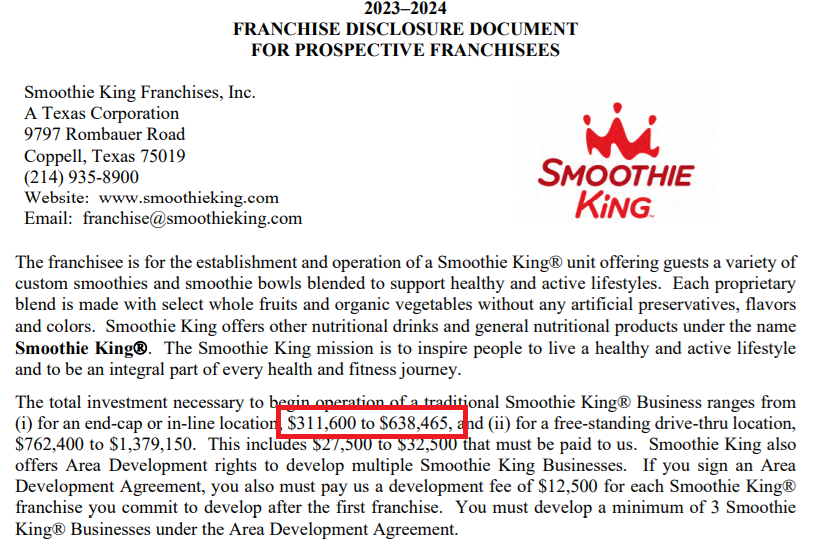
Here’s a thing that always bugs me that some companies do – report the annual gross revenues for top-performing stores. It’s a very convenient way to discard franchisees that aren’t doing well. Smoothie King, for instance, reports annual revenues of $950,000 for their top 25% of franchisees. Make of that what you will.
Mac Tools
Mac Tools, on the other hand, is a considerably different business. For one, it is often compared with Snap-on Tools and Matco. Like my analysis of Snap-on Tools, there are certain things I struggle with in this business.
The impression I got from researching this company specifically was that franchisees often go to forums to express their unhappiness, indicating the failure rate could be significant.
| 🔧 Key Item | 📋 Mac Tools Franchise Insight |
|---|---|
| Initial franchise fee | $8,000 (may be waived with qualified tool truck financing or through veterans program) |
| Total investment | $125,000 – $275,000 including truck lease or purchase, inventory, business setup, and working capital (startup package includes training, uniforms, signage) |
| Ongoing fees | No traditional royalty fee; instead, Mac Tools earns profit through wholesale margin. |
| Territory | Exclusive geographic route typically includes 300–400 flagged customer accounts (auto shops, dealerships, aviation service centers) |
| Day-to-day operations |
• Most reps start their route by 7:30 AM and finish by ~4:30 PM • Inventory management is key—lost shrink or slow-turn SKUs = dead cash |
| Hidden gotcha (consultant-level) | Mac Tools franchises are technically distributors, not lessees—this means YOU hold the inventory risk. |
| 🚀 Enquire | Talk to Thomas about Mac Tools ➜ |
Systemic issues, competition from Amazon, the fact that people don’t buy tools from a truck. Pick your poison, but I struggle to see this as the thing that will make franchisees happy as they’re changing career paths.
While national scandals are limited from what I could find, ex-franchisees haven’t been quiet. In a 2013 video titled “MAC Tools screwed us,” a different picture is painted than the one the company would probably prefer. In it, the said person describes not having drawn a paycheck after 14 months.
It’s not exactly the most recent reference to what their franchise situation may be like, but ask yourself if the current picture is necessarily better. I don’t know.
Whenever I need a tool, I tend to go to Amazon or Home Depot. I also wouldn’t want my Saturdays to be occupied driving an awkwardly big truck.
I also found a complaint alleging that a franchisee had been given a route that already had 3 prior, failed franchisees under its belt. It just doesn’t scream very transparent or helpful of the Mac Tools.
A loyal customer base is imperative to make this business successful, but it seems like more work than it’s worth, especially if the failure rate is easily double digit. I’d rather just operate a sandwich shop. Simpler operations, repeat business.
Leave a Reply